At Sportify Physiotherapy, we use a Hierarchy of Health model to explain why two people doing the same exercise program can experience very different outcomes.
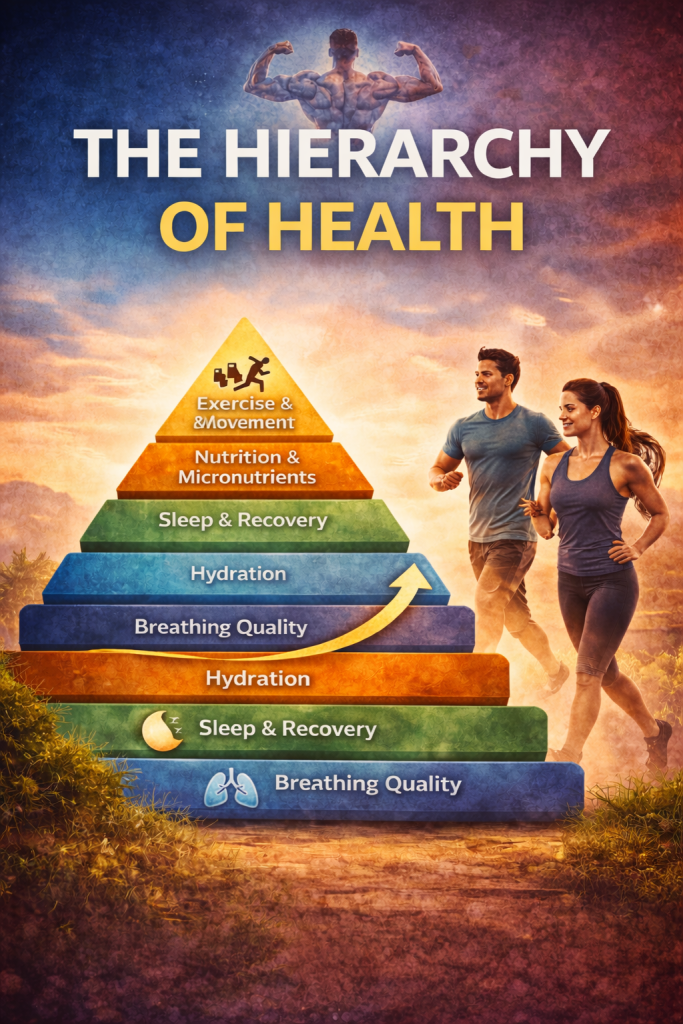
The hierarchy moves from basic recovery needs to performance:
1. Breathing quality
2. Hydration
3. Sleep & recovery
4. Nutrition & micronutrients
5. Exercise & movement
Exercise sits at the top, not the base. When the lower layers are weak, exercise becomes stress rather than stimulus.
Why Exercise Alone Often Fails
Many people focus only on workouts while ignoring sleep, hydration, breathing, and nutrition.
In such cases, we commonly see:
•Slow or stalled progress
•Recurrent pain or injuries
•Poor recovery and fatigue
•Loss of motivation
The issue is not the exercise program – it is the foundation supporting it.
A Common Pattern We See at Sportify
Person A (Strong foundation):
•Sleeps well
•Drinks enough water
•Eats balanced meals
•Manages stress and breathing
•Exercises regularly
Person B (Weak foundation):
•Poor sleep
•Dehydration
•Inconsistent nutrition
•High stress
•Exercises just as regularly
Outcome:
Person A progresses faster, recovers better, and stays pain-free longer, despite doing similar exercises.
How Each Layer Enhances Exercise Results
- Breathing:
Improves oxygen delivery, nervous system balance, and muscle coordination. - Hydration:
Essential for muscle function, joint health, and fascia movement. - Sleep:
The phase where tissue repair, hormonal balance, and learning occur. - Nutrition:
Provides the raw materials for muscle, tendon, and energy systems.
Our goal at Sportify is not just to reduce pain or improve fitness, but to help people understand how their body truly adapts and heals.
When the hierarchy is respected, exercise works faster, safer, and longer.
"Health is built from the ground up, not the top down"
Exercise is powerful – but only when breathing, hydration, sleep, and nutrition support it.
References:
1. McArdle, W., Katch, F., & Katch, V. (2015). Exercise Physiology. Wolters Kluwer.
2. Walker, M. (2017). Why We Sleep. Scribner.
3. Porges, S. (2011). The Polyvagal Theory. W.W. Norton & Company.
4. Schleip, R. et al. (2012). Fascia: The Tensional Network of the Human Body. Elsevier.